Switch to a non-nano zinc sunscreen, or better, cover up with a rash guard — it is the easiest thing you can change. But sunscreen is a small factor beside fin contact, anchoring and sediment, and an operator who tells you otherwise is selling comfort rather than conservation.
What does the evidence actually support?
Laboratory work has repeatedly shown that certain ultraviolet filters — oxybenzone and octinoxate above all — cause measurable stress responses in coral tissue and coral larvae at particular concentrations. That is the basis for the bans introduced in several jurisdictions, and it is a reasonable basis.
What the evidence supports less well is the leap from “harmful in controlled exposure” to “a leading cause of reef decline”. Concentrations in open water around a dispersed dive site are not the concentrations used in those studies. We will not inflate the claim, because the moment a traveller discovers a green message was exaggerated they discount all of them. Use the better sunscreen. Do not believe it is the main event.
| Ingredient | Concern level cited | Common alternative |
|---|---|---|
| Oxybenzone (benzophenone-3) | Highest — the ingredient behind most legislation | Non-nano zinc oxide |
| Octinoxate (octyl methoxycinnamate) | High — frequently banned alongside oxybenzone | Non-nano zinc oxide |
| Octocrylene, homosalate, avobenzone | Discussed, evidence thinner | Mineral filters |
| Nano zinc / nano titanium dioxide | Debated — particle size is the issue | Non-nano mineral formulations |
| Non-nano zinc oxide | Lowest of the commonly available options | — |
| No sunscreen at all — UPF clothing | None | Rash guard, leggings, wide-brim hat |
What are the bigger levers?
In rough order of how much damage a visiting diver can personally cause or prevent:
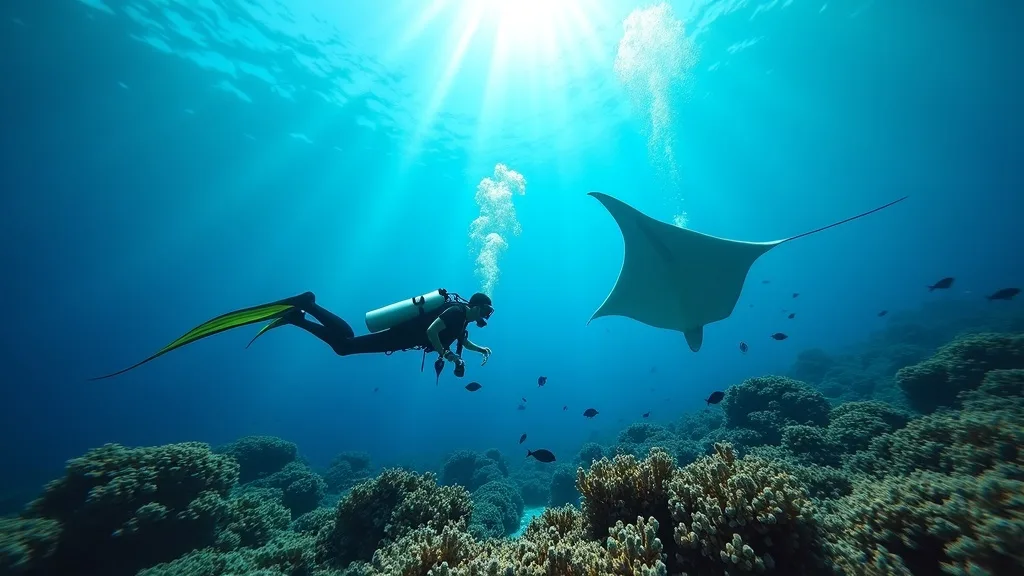
- Physical contact. Fin kicks into coral, a dragging octopus or gauge, a knee placed on a bommie to steady a camera. This is the one that leaves marks you can see on the next dive.
- Anchoring. An anchor dropped on coral destroys structure that took decades to build. Anchoring on coral is prohibited inside the marine protected area; boats should use mooring buoys or sand.
- Silt. Poor trim over a sandy cleaning station clouds the site and buries the organisms working there.
- Waste. Anything that goes over the side, from a plastic wrapper to untreated greywater near a reef.
- Sunscreen chemistry. Real, worth fixing, and last on this list for a reason.
Buoyancy is a trainable skill, not a personality trait. If yours is rusty after a long break, a refresher or an Advanced course on day one is the highest-value hour of the trip — see the onboard dive courses and nitrox page.
Why is clothing better than any sunscreen?
Because it works continuously, it does not wash off into the water, it does not need reapplying, and it protects you far better during six hours on an equatorial deck than any lotion will. A long-sleeved rash guard, leggings for the snorkel sessions, a wide-brimmed hat and sunglasses cover the problem almost entirely. Reserve sunscreen for hands, feet and face — the places fabric does not reach.
There is a diving benefit too: a full-length rash guard under or instead of a thin wetsuit reduces stings from hydroids and gives some abrasion protection. Sizing and layering are covered in our water temperature and wetsuit guide.
What should an onboard briefing cover?
On day one, before the first dive, a competent Raja Ampat operation should tell you: which sunscreens are requested and why; that nothing is touched, moved or fed; that gloves may be discouraged; where the drinking water refill point is and that no single-use plastic bottles are supplied; how waste is sorted and that it goes ashore rather than over the side; and what the anchoring policy is.
If a briefing skips all of that, the “eco” in the vessel’s name is marketing. We set out nine specific questions worth asking before you book in how to judge an eco liveaboard, and the practical inclusions each vessel commits to are listed on the inclusions and booking page.
What else can you leave at home?
- Wet wipes. Almost always plastic-based, and they end up in the boat’s waste stream or worse.
- Microbead exfoliants and glitter cosmetics. No sensible route into a marine protected area.
- Single-use plastic bottles. Any decent vessel runs a reverse-osmosis watermaker; bring a refillable bottle instead.
- Shell and coral souvenirs. Do not buy them at village stops. Buy woven goods, carving and food from the people who made them — the etiquette is covered in the village and topside guide.
Where the money you already pay goes — patrols, moorings, ranger salaries — is set out in where your Raja Ampat fees actually go.
Want our onboard environmental policy in writing before you book? Message Komodo Luxury on WhatsApp at +62 811 3823 875 or email [email protected] with your travel window, certification level and party size. We reply with the vessels available on those dates, the cabin-by-cabin rate and a plain list of what is not in the price.
Frequently asked questions
Is reef-safe sunscreen actually required in Raja Ampat?
It is not a legal requirement across the archipelago, but many operators, including us, ask for it and some marine protected areas elsewhere in the world now mandate it. The stronger reason to switch is that it costs you nothing and removes one avoidable input. Covering up with a rash guard removes far more.
Which sunscreen ingredients are the concern?
Oxybenzone and octinoxate are the two most commonly cited in laboratory studies of coral stress, and they are the ingredients banned in the jurisdictions that have legislated. Non-nano zinc oxide is the usual alternative. The honest caveat is that much of the evidence comes from controlled exposures rather than reef-scale field measurement.
Is sunscreen really a major threat to coral reefs?
No, and anyone telling you otherwise is skipping the uncomfortable part. Ocean warming, destructive fishing, sediment runoff and physical damage do vastly more harm. Sunscreen is a small, cheap lever that a visitor can pull personally, which is why it gets attention out of proportion to its impact.
What is the single most useful thing a diver can do for the reef?
Fix your buoyancy. Fin contact, dragged gauges and knees placed on coral to steady a camera cause visible, repeated, cumulative damage on exactly the shallow sites that divers love. A diver with good trim who never touches anything does more for a reef in a week than a sunscreen choice does in a lifetime.
Do I need to worry about what soap and shampoo I use on the boat?
It is worth asking. Boats with holding tanks and shore disposal are unaffected; on vessels that discharge greywater, biodegradable toiletries genuinely help. It is a reasonable question to put to any operator, and the answer tells you a lot about how the rest of the waste stream is handled.
This guide is published by the team behind this Raja Ampat eco liveaboard site — Komodo Luxury, part of Juara Holding Group, running dive and cruise operations in eastern Indonesia since 2015. Questions on a specific date or vessel: WhatsApp +62 811 3823 875, email [email protected].